


Removing NCSEI may involve reducing the financial incentives of distributing such content. If you discover a website monetizing NCSEI content, reporting copyright infringement directly to payment processors like MasterCard is a powerful tool for enforcement. MasterCard’s Anti-Piracy Policy strictly prohibits the sale of copyright-infringing products and services. By alerting service providers to illegal activity, you can disrupt a site’s ability to process transactions and generate revenue.
This guide outlines how to identify MasterCard’s involvement and report infringing content using MasterCard’s Anti-Piracy Referral Form.
Pre-Requisite: Three Attempts of Notification
Before filing an official referral, MasterCard requires proof that you have attempted to resolve the issue directly. You must document at least three attempts at correspondence, such as:
- DMCA Takedown Notices
- Cease & Desist Notices
- Notices sent to the website owner or web hosting provider.
- Notices sent to Cloudflare or other upstream providers
Step 1: Collect Evidence of MasterCard Involvement
You must prove the website relies on the MasterCard network, either through direct payments or ad revenue.
Option A. Direct-to-Consumer Payments
Look for the MasterCard logo either on the website footer or on the checkout page.
Investigative Tip - Test Payments:MasterCard provides official test cards for developers and investigators to validate payment gateways. You can use these to confirm if a merchant system is configured to accept MasterCard without processing a real transaction. For more details, check out the official documentation atMasterCard | Test Cards Information.
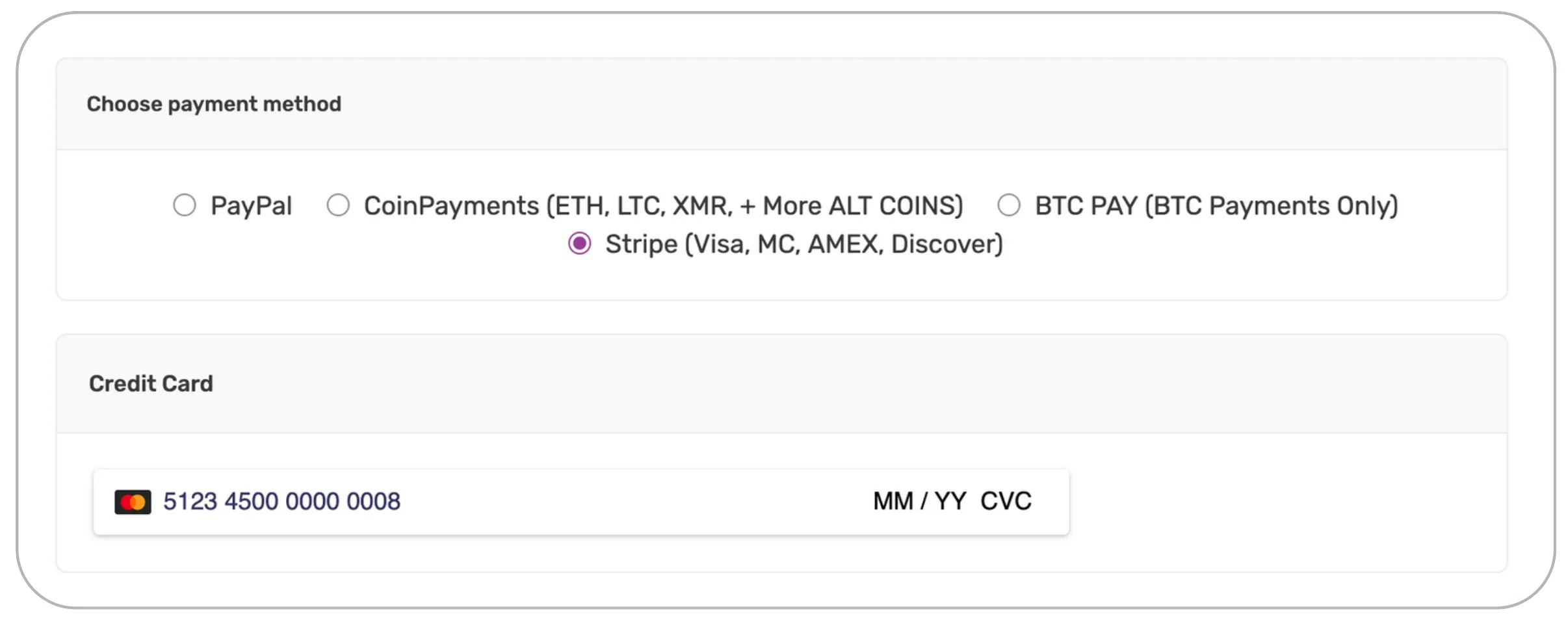
Demonstrating MasterCard payment support using a test card from MasterCard.
Option B. Advertising Networks
Many sites monetize indirectly. To see if an ad network is funded via MasterCard:
- Open your browser’s Developer Tools (Right-click > Inspect).
- Press Ctrl + F and search for elements mentioning “ads” to identify the ad provider’s domain.
- Research the domain to locate the ad provider, and confirm if the ad network accepts MasterCard from their clients.
Step 2: Collect Evidence of Copyright Infringement
MasterCard requests several types of evidence to submit an Anti-Piracy Referral Form.
- Infringing URLs: Direct links to the specific pages where the content is being monetized.
- Correspondence History: MasterCard requires documentation showing that you have already attempted to contact the provider at least three times.
- Copyright Registration: If applicable, evidence that you are the rights holder or an authorized representative.
Step 3: Filing an Anti-Piracy Referral
Referral forms can be found on MasterCard’s official website, MasterCard Anti-Piracy Referral Form.Send completed forms and evidence to ipinquiries@mastercard.com.
Conclusion
Demonetization is a highly effective takedown strategy because NCSEI content is not just removed, but made unprofitable. While the process requires diligence, particularly in documenting prior contact attempts, the result of a successful MasterCard Anti-Piracy Referral may lead to a severe reduction of a malicious website’s ability to profit from their content distribution. By submitting these reports, you are not just reporting a violation; you are actively dismantling the infrastructure that financially incentivizes exploitation.
This post was last updated on December 24, 2025.