If you’ve found NCSEI content on Yandex, getting it removed is a priority. However, not all removal paths are created equal.
For Yandex, we’ll go over two primary routes for content removal: the Copyright Complaint and the NCSEI (Non-Consensual Sexual Explicit Imagery) / Deepfake route.
Here is a breakdown of how to navigate these forms and why, in many cases, the copyright route is the more efficient choice.
Options for removing NCSEI on Yandex
- Copyright Complaint Route: This method is generally faster and requires significantly less personal data. Form: Yandex - Copyright Notice Policy
- NCSEI / Deepfake Route: This is specifically for non-consensual explicit content or AI-generated “deepfakes.” While this form addresses a specific harm, the barrier to entry is much higher. Form: Yandex - Report Explicit content without my consent
Why I Recommend the Copyright Route
I realize not all NCSEI is copyrighted content. However, when dealing with NCSEI, privacy is often the goal. Ironically, some removal forms require you to hand over more sensitive data than the content you are trying to remove.
Yandex’s NCSEI form is extensive. It requires you to provide legal proof of identity (such as a government ID) and proof that you have already attempted to contact the website owner to ask for removal. For many survivors, submitting legal identification poses an additional security risk, and a legal representative may not be accessible to everyone.
Conversely, Yandex’s Copyright Form is not as stringent. It does not explicitly demand personally identifiable information (PII) or ID uploads to submit the initial request. Less is more when it comes to reporting copyrighted content on Yandex.
Filing Copyright Notice for Yandex
For Yandex, providing concise, clear answers is often more effective than writing long explanations. Over-explaining can sometimes lead to technical rejections.
If you are acting on your own behalf, here is a brief guide for filling out the form:
Q: Name, address and contact details of the copyright holder you represent (or indicate that you act in your own name)
- A: I act in my own name.
Q: Type, identification and description of the copyrighted work claimed to have been infringed
- A: Unauthorized distribution of content.
Q: Precise location (URL) of the authorized copy of the work (for example, if the authorized copy is available on the copyright holder’s website) or specify that the work is not available online
- A: Work is no longer available online*.*
Q: Identification of the material that is claimed to be infringing and nature of the infringement
- A: Unauthorized distribution of content.
Q: Legal ground for finding infringement (please refer to relevant provision of applicable law)
- A: DMCA
Final Thoughts
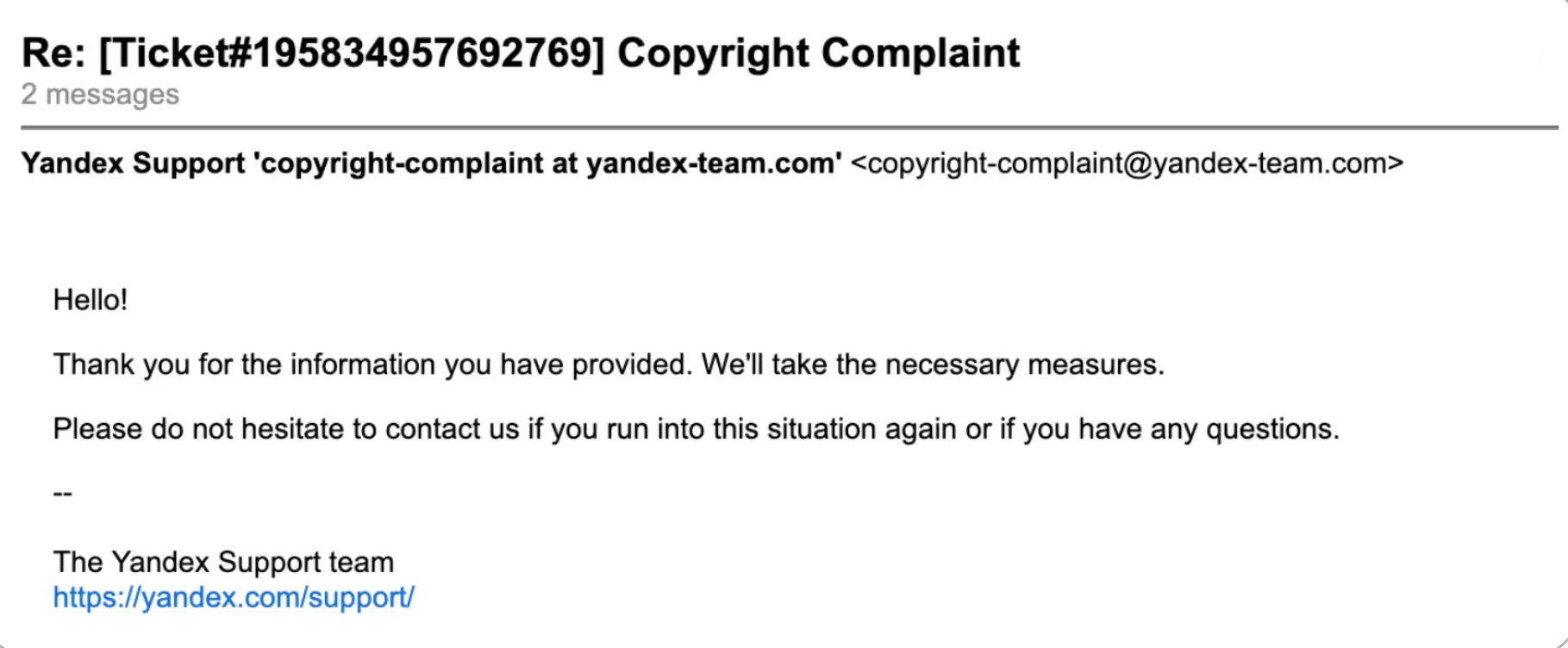
Yandex typically sends an automated confirmation via email. Keep this for your records.
If possible, ensure the content is removed from the host website first. Once the source is gone, Yandex’s Outdated Content form can be used to clear the search result.
This post was last updated on December 22, 2025.